
Download the report
The importance of managing climate-related risks cannot be understated and is fast becoming a critical internal activity for most companies, shaping corporate strategy and guiding mitigation actions. Such risks can arise from direct physical impacts on assets due to extreme weather events (Physical Risks) or from the broader transition to a low-carbon economy (Transition Risks).
To stay competitive, companies should have a clear understanding of how the transition to a low-carbon economy can impact strategy, business model, customer preferences, technological innovation, and supply chains.
This new 𝐩𝐫𝐚𝐜𝐭𝐢𝐜𝐚𝐥 𝐠𝐮𝐢𝐝𝐞 helps you stay ahead by:
🔍 Breaking down key climate-related transition risks
📊 Exploring the role of scenario analysis in risk assessment
🛠️ Offering a step-by-step methodology with an illustrative case study
/ / / / / / / /
From Uncertainty to Strategy - Tackling Climate Transition Risks head on
Achieving net-zero emissions by 2050 will require a fundamental transformation of the global energy system. This transformation will combine widespread deployment of clean energy technologies, electrification, and a significant reduction in coal, oil, and gas consumption. We have already started to observe such shifts both within Switzerland specifically and wider European market in general.
As such, this transition is expected to have profound economic implications, affecting numerous industries and impacting corporate financial performance of most companies in such industries. For example, WEF estimated that carbon pricing alone could impact fossil fuel utilities and energy-intensive sectors such as materials, metals, and chemicals potentially reducing their EBITDA by up to 50% by 2030.[1]
To assess these risks, companies often conduct Scenario Analysis, a risk management tool that evaluates the potential impact of different future scenarios on business performance.
What is Scenario Analysis?
Scenario Analysis is a powerful risk-management tool that companies can use to assess and quantify impact of climate-related risks on business performance in selected scenarios. In its fundamental logic and application, scenario analysis is comparable to “financial sensitivity analysis” companies have conducted for decades to measure the impact of variations in various input prices (for example energy prices) or other variables (for example FX fluctuations) on the overall company bottom line. In Scenario Analysis, however, instead of testing the impact of individual variables, distinct scenarios (plausible futures) are envisioned each having respective assumptions and variables to be tested.
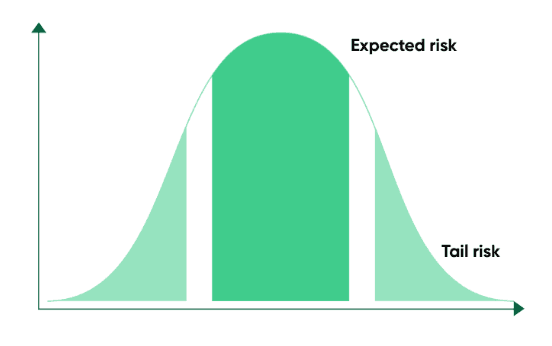
A scenario describes a plausible, but hypothetical, path of development leading to a particular future outcome. Scenarios are not forecasts or predictions - they are “what-if” narratives designed to inform and challenge strategic thinking. It allows companies to stress test unexpected risks or “tail risks” as depicted in Figure 1.
As such, scenario analysis allows a company to understand the risks and uncertainties it may face under different hypothetical futures and how those conditions may affect its performance.
Figure 1 - Expected and Tail Risks
Scenario analysis can identify key drivers of change and pathways of development. A company can use it to monitor and understand which outcomes are emerging and apply “midcourse corrections” if/as needed. It contributes to greater strategy resilience and flexibility by:
testing a strategy and its options against a set of scenarios
identifying possible future threats or opportunities
identifying trigger points to set contingency plans in motion and
serving as a basis for continuous monitoring and strategy adjustment
How to use Scenario Analysis to assess Transition Risks
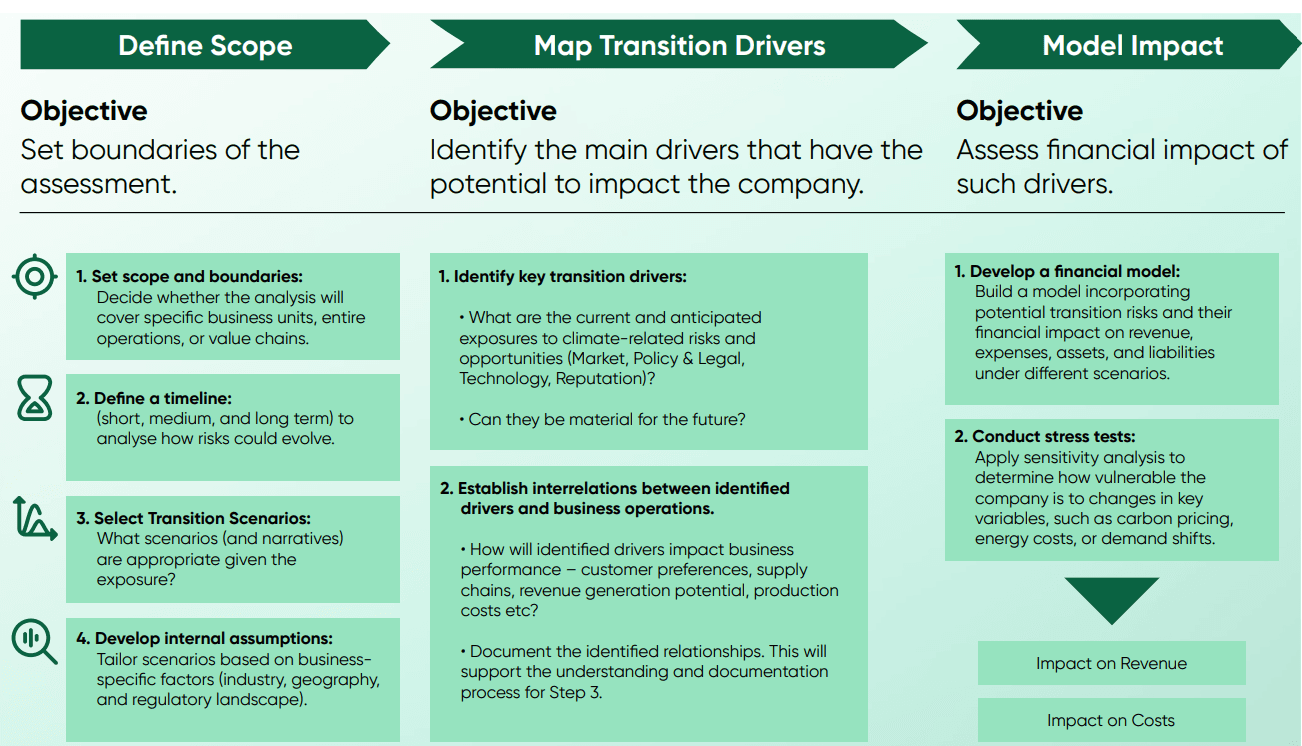
Scenario analysis is typically structured along three stages as defined below:
1. Defining Scope & Boundaries – In the first stage, a company defines the scope of analysis both in terms of business activities and geographies. Furthermore, it establishes the assessment framework and selects relevant scenarios. For transition risks, companies typically rely on scenarios from the International Energy Agency (IEA), which outline different pathways for the global energy system based on policy, technology, and societal developments. For example, the Stated Policies Scenario (STEPS) reflects the current policy environment and is essentially the “business as usual” scenario while Net Zero Emissions by 2050 Scenario (NZE) lays out a detailed pathway for the global energy system to achieve net-zero greenhouse gas emissions by 2050.
2. Mapping Key Transition Drivers – In the second stage, a company maps main transition drivers and assesses their impact on different business areas under each scenario. This should be done in collaboration with relevant business units and stakeholders. For example, if a shift in customer demand for low-emission products is outlined as a potential risk, then sufficient information should be gathered. Some guiding questions in this respect would be:
Does the company have any data on a potential customer preference shift? Is there market data available to support such a trend and better understand it?
Are competitors putting efforts in R&D for such product design improvements?
Are there any regulatory changes that may impact a faster shift?
What are the CAPEX implications and plans for any product improvements?
What could be the impact of such developments on revenues and costs?
3. Modelling Financial & Operational Impact – In the third sage, a company integrates scenario assumptions (from stages 1 and 2) into impact models, linking them with company-specific operational data (e.g., production, costs) to assess impact and generate insights. Companies can estimate CAPEX assumptions for any mitigation measures and assess financial impact of each scenario against company financials metrics such as revenue, costs, EBITDA, CashFlow.
This process is illustrated in the figure below.
Figure 2 - Main steps of Scenarios Analysis
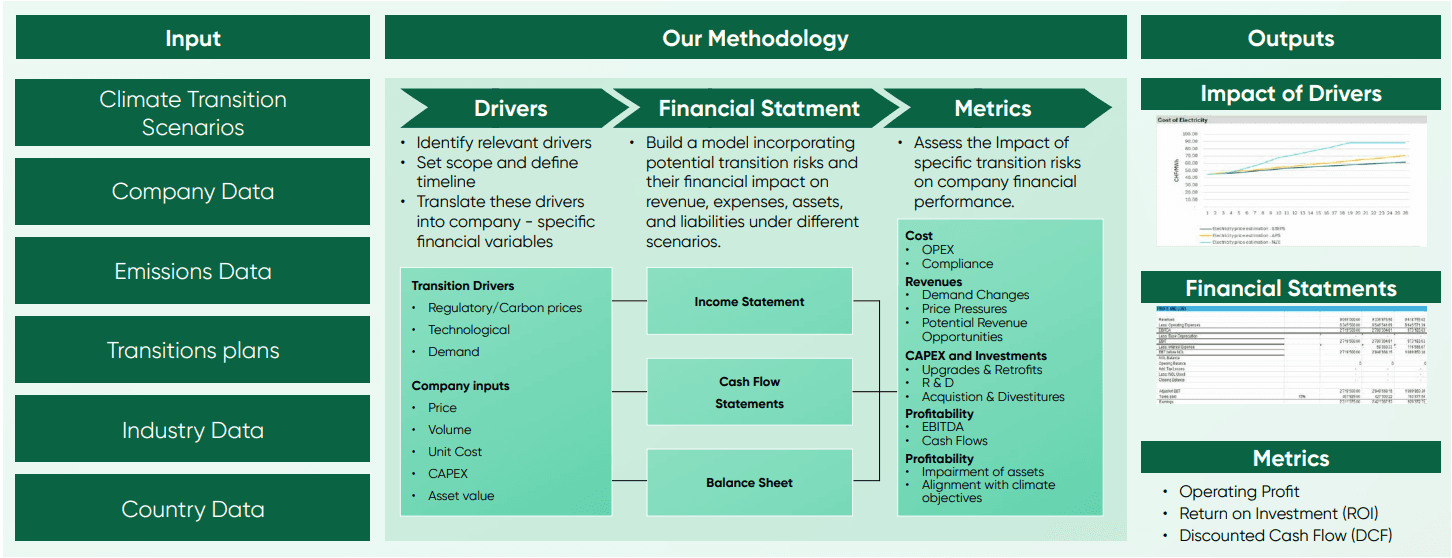
The objective of this exercise is to provide a company with a comprehensive understanding of the main material transition drivers that may impact its performance. Such drivers should be well defined (for example risk of carbon taxes on emission), mapped and translated into quantifiable elements that are modelled to measure impact. In Figure 3 we present an overview of Enfinit`s methodology in assessing the impact of transition risks on company financials such as EBITDA and Cash Flow.
Figure 3 - Enfinit's methodology: impact of transition risks on EBITDA or Cash Flow
Key areas to consider when using Scenario Analysis to assess Transition Risks
Clear scoping
Define key questions and metrics based on company and industry needs (e.g., NZE-aligned building share for real estate or EBITDA impact for manufacturing).
Start with a narrow scope to understand key drivers before scaling up. Focus on one business division to refine mechanics efficiently.
Prepare a project memorandum to bring everybody on board, describing the scope and objectives.
Use public scenarios and adjust locally
Use public IEA Scenarios for general trends.
Global scenarios often lack the granularity required for localised risks.
Incorporate company-specific data and avoid sole reliance on opaque commercial models.
Understand the risk drivers
Identify and document material risk drivers and their impact on performance.
Engage key departments through workshops for diverse perspectives.
Prioritize which drivers to quantify and plan reporting formats.
Document narratives and describe inter-dependant relationships.
Build In-House Expertise
Work with third parties to build models tailored to your needs.
Develop internal skills to understand models and assumptions.
Create capacity to build and maintain tools to ensure flexibility for future adjustments.
This section is an excerpt from our detailed guideline on Transition Risks. For a more comprehensive framework, including an illustrative Case Study, please refer to the full document - From Uncertainty to Strategy: Tackling Climate Transition Risks Head-On.
Qendresa Rugova | Managing Director | qrugova@enfinit.ch
[1] : Cost of Inaction, WEF, 2024