Download the report
April 2026
In 2023 and 2024, we published two consecutive studies assessing the alignment of Swiss companies with the reporting requirements set out in the Swiss Ordinance on Climate Disclosures (OCD), which entered into force in January 2025. The studies highlighted substantial gaps, particularly in how companies disclosed potential impacts of climate-related risks on company strategy and financial performance (also known as 'financial materiality').
In this year’s edition, we review the first set of reports prepared in compliance with the OCD, maintaining a consistent methodology and sample of 50 publicly listed companies. The report is structured around the TCFD framework, presenting results for each of the four pillars: Governance, Strategy, Risk Management, and Metrics & Targets. For each pillar, we also highlight selected best practices observed among Swiss companies to support ongoing improvements in climate-related disclosure.
/ / / / / / / /
Climate Reporting in Switzerland:
Reporting on climate-related topics has improved notably across all four pillars, suggesting that Swiss companies are aligning with the Ordinance on Climate Disclosures. However, progress has been more pronounced in areas pertaining to description of processes, such as board oversight, the identification of material climate-related risks and opportunities (including double materiality assessments and scenario analysis), and risk management. By contrast, reporting on how these risks affect company performance tends to be high- level and lacking in detail, with the least progress observed in strategy resilience, financial implications of climate-related risks, and transition plans.
Governance, as it relates to sustainability, continues to be in line with TCFD Recommendations though climate-specific topics should be further incorporated and disclosed. Board oversight on sustainability matters is well highlighted and has increased considerably year-on-year (an increase from 78% to 92%). Disclosures related to how boards consider climate-related issues when reviewing and guiding strategy and business plans have also significantly improved from 64% to 90%. Management`s role is also well addressed and shows a marked improvement from the previous year. However, disclosures related to the relevant roles and responsibilities of different business functions and processes by which management is informed about and monitors climate- related issues remains underreported. Lastly, we also see a significant increase in companies that disclose partial information demonstrating an increased effort by the companies to respond to reporting requirements.
Strategy-related disclosures show moderate improvement, but gaps remain in disclosures on impact of climate-related risks and opportunities, and strategy resilience. More than two thirds of the companies clearly disclose the process by which they identify material climate-related topics impacting their companies (Double Materiality Assessment), coupled by a clear definition of time-horizons. However, disclosures related to the impact of climate-related risks on businesses continue to be underreported with roughly only one third of the companies doing so. Climate-related impacts are often presented in a theoretical and generic manner and are not always concretely linked to impact on performance, strategy or financial planning. Lastly, company resilience to climate-related risks is still widely underreported with less than 20% of the companies reporting on how resilient their strategies are to climate-related risks.
We have also observed a distinct delineation in disclosures between companies that manufacture products which are naturally better placed in a net-zero environment, such as efficient technologies, and those that are in more energy intensive industries. The former clearly highlight such product features and strategic direction as key pillars of their resilience while the latter tend to focus more on environmental materiality i.e. their efforts in meeting climate targets and provide less context as to their strategy. Nevertheless, it is encouraging to see that disclosures on the impact on financial performance and use of scenario analysis have improved significantly (an increase from 16% to 52%).
A notable improvement is observed in disclosures related to Risk Management; however, some areas are still lagging. Disclosures have improved significantly, especially in terms of risk identification and risk management. In addition, solid progress is observed in the disclosure of material physical and transition risks (an increase from 36% to 66%). However, they often tend to lack depth, rely on qualitative descriptions which are not sufficiently detailed or linked to company activities. Moreover, reports also do not provide sufficient details on how they assess the size of climate-related risks (a slight decrease from 28% to 26%). Disclosures about integration of risks tend to score better and have seen some improvement from last year.
Findings related to disclosures on Metrics and Targets continue to show a disparity between Environmental and Financial materiality. Metrics and targets related to GHG emissions exhibit a high level of alignment. Additionally, most of the companies fare well in terms of disclosures for other environmental related metrics with more than 70% of the companies disclosing information pertaining to energy, waste and water. In addition, 60% of companies had some of the metrics verified by a third party. However, we continue to observe a misalignment in metrics and targets that pertain to financial materiality.
For example, our study shows that only 9 companies (18% of the total) presented metrics related to business activities impacted by physical risks and 6 companies (12%) disclosed metrics related to CAPEX deployed towards climate-related risks and opportunities. Similarly, only 11 companies out of the 50 assessed (or 22%) have a clear transition plan in place. On a more positive note, companies that provided a transition plan have considerably improved the level of detail provided as it relates to levers and activities planned to reach their targets. Lastly, when it comes to disclosure of the financial implications of climate-related risks, we have observed an incremental year-on-year improvement, however disclosures in this area remain quite low (18%).
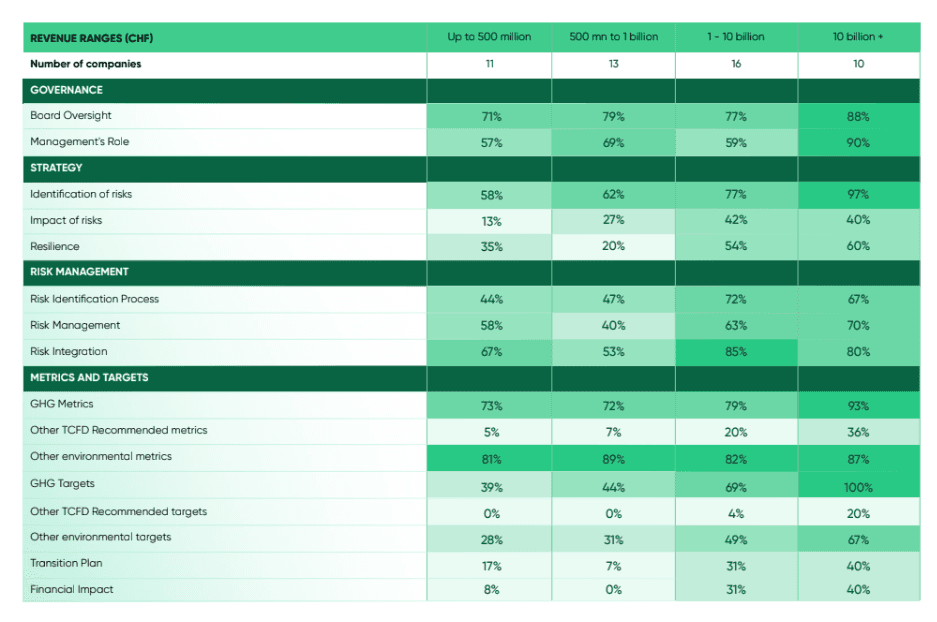
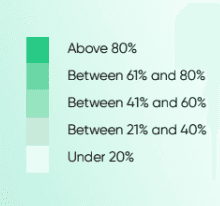
Lastly, and probably as expected, companies with higher revenues exhibit stronger alignment across all four TCFD categories. Like last year, we find that companies generating annual revenues exceed CHF 10 billion can be considered the most aligned with TCFD requirements. However, even these sizable companies do not fully align with TCFD recommendations regarding physical and transition risks, financial impact disclosure, and detailed transition plans. Nevertheless, latest reports show an emerging trend whereby smaller companies have made a substantial progress across most the categories compared to the previous reports demonstrating the direct impact of reporting requirements. The table is a visual depiction of how companies align with TCFD recommendations according to their annual revenue, where the percentage represents the share of companies within revenue range group that had clear disclosures and therefore considered a “Yes” in our assessment.